Higher Diploma in Language and Corporate Communication (Japanese)

Introduction
This unique sub-degree program offers a double major in Japanese Language and Marketing Communications, focusing on practical Japanese language skills for professional use. It develops students' corporate communication skills and practical business knowledge, broadening their horizons in fields such as Japanese language, public relations (PR), marketing, and more.
 
 
Programme Enquiry: WhatsApp
Professional Qualification

Hong Kong Public Relations Professionals' Association Limited (PRPA) 
Students can apply for the Associate Member of Hong Kong Public Relations Professionals' Association Limited
PRPA will provide professional talks to HKCT students

Public Relations Hong Kong Limited (PRHK) 
Students can apply for the Student Member of Public Relations Hong Kong Limited

Contents

Programme Objectives

This Higher Diploma programme in Japanese Language and Corporate Communication cultivates strong Japanese communication skills, equipping students with effective marketing communication strategies and essential business knowledge. Students benefit from expert instruction, a study tour to Japan, and internship opportunities, broadening their horizons and practical experience. The program prepares students for the Japanese-Language Proficiency Test (JLPT), providing a recognized qualification for further studies at universities in Hong Kong or Japan. Furthermore, it emphasizes the development of crucial business skills, including public relations and corporate communication, preparing graduates for careers in local, Japanese, or international companies, paving the way for future career development.

Course Feature

  • 【Professional team】Our teaching team brings together experienced Japanese language instructors and experts in public relations and communications. This combination of skills allows them to address specific challenges in learning the language while providing real-world industry insights, ensuring students fully understand professional requirements.
  • 【Articulation to Japanese universities】Recognised by Nagasaki University of Foreign Studies and Nagasaki International University; graduates are eligible to apply for senior-year (3rd year) entry of the Bachelor’s Degree programme.
  • 【Articulation to local universities and organizations】Recognised by Hong Kong Shue Yan University, graduates are eligible to apply for senior-year (3rd year) entry of the Bachelor’s Degree programme. Some graduates have been admitted to the senior year of UGC-funded Bachelor's Degree programmes of CUHK, PolyU, CityU, HKBU, EdUHK, etc. Additionally, the programme is recognised by The Japan Society of Hong Kong, graduates' proficiency is deemed equivalent to 'Japanese General 2', granting exemption from the proficiency test for entry into 'Japanese General 3'.
  • 【Japanese language qualification】Attainment of advanced levels in “Japanese Language Proficiency Test” (JLPT) can be completed within 2 years only. Some of our students have succesfully achieved the highest levels N1 and N2 in JLPT
  • 【Study tour and Internship】The programme arranges study tours to Japan and provides internship opportunities in Japanese language and communication sectors, broadening students' perspectives and practical experience.
  • 【Scholarships and Financial Support】Various scholarships are available, including subsidies for the Japan Study Tour for students with financial needs, and awards for students achieving excellent results in the JLPT.
  • 【Industry support】HKCT has been collaborating  with the Japan Cultural Association for 8 years to promote Japanese language and culture. To nurture talent in communications and public relations, HKCT has partnered with the Hong Kong Public Relations Professionals' Association (PRPA) and Public Relations Hong Kong Limited (PRHK) for over 8 years and 5 years, respectively.


Course Content

  • Japanese Language and Culture
  • Professional Japanese Communication
  • Media for Presentation
  • Principles and Practices of Corporate Communication and PR
  • Marketing and Advertising
  • Public Relations Writing
  • Event Planning and Promotion

Credits earned from specific modules (Japanese and Corporate Communication) account for almost 80% of the total credits  

Highlights
Through visiting shrines with distinctive religious and cultural features and wearing yukata, students knew more about Japanese traditional culture and customs.
Gratituded to the Hiroshima International Centre for coordinating the HKCT Japan exchange programme and issuing attendance certificates to the students.
During the exchange programme in Japan, the students visited Kamotsuru Brewery in Higashi-Hiroshima City to learn about Japan's sake brewing history.
Students experienced Taiko drumming, a performance using traditional drums that are an essential part of Japanese festivals.
Students crafted Hiroshima Prefecture's Itsukushima specialty food, the “Momiji Manju”, gaining insight into regional Japanese culinary culture.
Students prepared “Okonomiyaki” to learn about regional Japanese culinary culture
Students applied their event management and promotional skills to organise and promote a 'Japan-Korea Cultural Festival' within the school.
Through visits to agencies specialising in job placement services for Japanese companies in Hong Kong and participation in career seminars, students gained insight into market conditions and job-seeking information.
In the “Japan Cultural Exchange Study Tour”, the students visited the university and engaged in group activities with local undergraduates, exchanging insights into the lifestyles and cultures of both regions.
Representatives from Public Relations Hong Kong Limited (PRHK) shared the latest developments in the field
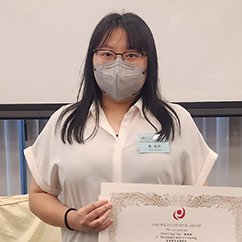
Congratulations to our graduate, Lo Tsz Kiu, was awarded the 2024-2025 SOJLEHK Scholarship (out of total 5 scholarship winners in the current year)
Congratulations to our graduate, Chan Nga Ting, was awarded the 2021-2022 SOJLEHK Scholarship by Mr. OKADA Kenichi, Consul General (Ambassador) of Japan in Hong Kong
Graduation Path

Articulation Path 

Graduates may also apply for the following bachelor's degree programmes:

1. The articulation agreement with the following oversea universities allow our graduates to articulate to senior year of the bachelor degree programmes (written / oral entry test required). 

  • Nagasaki University of Foreign Studies
  • Nagasaki Internation University  

2. Graduates may also apply for the following bachelor's degree programmes offered by local universities, including but not limited to:

  • Hong Kong Shue Yan University - bachelor's degree
  • The University of Hong Kong - Arts in Japanese Studies
  • The Chinese University of Hong Kong - Bachelor of Arts in Japanese Studies
  • UOW College Hong Kong - Bachelor of Arts (Honours) in Japanese Studies
  • The Hang Seng University of Hong Kong - Bachelor of Translation with Business (Honours)
  • Hong Kong Shue Yan University - Bachelor of Arts (Honours) in Journalism and Communication

3. This Japanese programme is recognized by the Japan Society of Hong Kong . Graduates achieve a Japanese language proficiency equivalent to the second year of the Japanese General Course and are eligible to directly enter the third year of the course without taking a placement test.


Career Prospects

Graduates can pursue careers in local, Japanese, or international companies, taking on roles such as editors, translators, public relations officers, project coordinators, marketing assistants, and corporate communication assistants, where Japanese language communication skills and knowledge of Japanese culture are essential.

Tutor Profile

Our teaching team has quality teaching and extensive professional experience. 

Our Japanese Teaching Team:
25 years of Japanese teaching experience
Invigilator for Examination for Japanese University Admission for International Students (EJU)
Provide guidance to settle the difficulties encountered at different stages

Our Corporate Communication Team:
Practitioners in the PR and Communication field for over 15 years  

Mode of Study

Full Time

Teaching Mode

Face to face

Commencement of Study

September 2026

Duration

2 Years

Location
Entry Requirements
  1. Attained Level 2 in 5 HKDSE subjects1, including Chinese Language2 and English Language, and the performance in Applied Learning subjects would be considered on a case-by-case basis; or
  2. Pass in 1 A-Level or 2 AS-Level subjects in HKALE; and 5 passes in HKCEE including Chinese Language and English Language; or 
  3. Holder of Diploma Yi Jin/ Diploma of Applied Education; or
  4. Holder of Diploma for Tertiary Studies; or
  5. Holder of Pre-Associate Degree; or
  6. Holder of Diploma and 
    - in the relevant discipline at QF Level 3 with a total learning size of normally 150 QF Credits; and 
    - learning contents covering Chinese and English Languages; or
  7. Aged 21 or above with 1 year working experience; or
  8. Equivalent qualifications; 
    AND
  9. Pass the admission interview.

1 With effective from 2024/25, 'Attained' in 'Citizenship and Social Development' (equivalent to 'Level 2' for the HKDSE subject 'Liberal Studies' before 2024/25), or the attainment of 'Level 2' in Mathematics Extended Part (Module 1 or Module 2) is also recognised as meeting the general entry requirements.
2 'Attained' level of Applied Learning Chinese (for non-Chinese speaking students) is accepted as Chinese Language qualification for the admission, but it is not considered as an elective subject.

Language Centre
Language Centre provides a cozy environment where students can immerse in learning Japanese, Korean languages. The facilities include Theatre, Chat Café, Individual Studio, Workshop world and Treasure Island. Chat Café is a signature area where students enjoy sipping a cup of coffee while chatting with our native speakers on daily-life topics
Click 360º to view the 360º VR tour of Language Centre

LO Tsz Kiu Rachel

Awardee of the Hong Kong Japanese Language Education Research Association Scholarship (SOJLEHK Scholarship)
"I am deeply grateful for the dedicated guidance of my teachers over these two years. The programme not only solidified my foundation in the Japanese language but also deepened my interest in both the language and its culture.
I was thrilled to be awarded the "Society of Japanese Language Education Hong Kong Scholarship" (SOJLEHK). At the award ceremony, I had the opportunity to deliver a speech in Japanese in front of the assembled guests, where I shared my unique experiences and observations from a trip to Hakone. It was a truly unforgettable experience."


Lo Cheuk Hei

Articulation to Nagasaki Internation University
"During the two years of study, I have not only mastered Japanese, but also gained extensive corporate communication knowledge including public relations writing and event planning management to develop proficient communication skills. One of the most unforgettable experiences was the ‘Wai Yin Association Japan Language and Culture Study Tour’. I have applied what I had learnt at school and broadened my horizons through immersing in the local culture and values.
I reaped the benefits with my sustained effort and was awarded the Wai Yin Study Tour Scholarships for Language Majors, Reaching Out Award by Educational Bureau, etc. All of which has helped develop my drive to succeed."


Chan Nga Ting

Awardee of the Hong Kong Japanese Language Education Research Association Scholarship (SOJLEHK Scholarship)

"I am very pleased to have received ‘The Society of Japanese Language Education Hong Kong Scholarship’. I want to express my heartfelt appreciation to my teachers for their dedicated guidance over the past two years. I have an interest in the Japanese language, and the programme of ‘Higher Diploma in Language and Corporate Communication (Japanese)’ has helped me strengthen my understanding of Japanese. It has deepened my interest in the Japanese language and culture, such as cuisine and work culture, which will be very beneficial for my future studies in Japan."

SIU Sum Yee

"The close, supportive relationship with passionate teachers has been invaluable. Initiatives like the ‘Chat Café’ improved my language skills, while the corporate communication training enhanced my daily interpersonal interactions. The solid foundation I gained at HKCT has been essential for my current Japanese Studies. I’m also deeply grateful to the mentors and seniors for their inspiring career guidance."


Wong Wun Yin

"In the beginning, I wanted to get a certificate in order to find a job. During my study in Diploma Yi Jin and Higher Diploma at HKCT, I joined various professional activities organized by the College, and I got an award in public writing competition. It aroused my interest in Japanese language and culture, and built my confidence in using Japanese in different occasions. I am happy to apply what I have learnt during working in a Japanese company."

QF Level
The qualification of this programme is recognised under the Qualifications Framework in Hong Kong.
QF level:4
QR Registration No.:15/000062/L4
Registration Validity Period:1/9/2015 to 31/8/2027

Applicants who do not meet the entry requirement may apply for a 1-year Diploma of Applied Education (listed below) and articulate to this higher diploma programme.
Diploma of Applied Education (Japanese Language and Popular Culture)

Is a background in the Japanese language required for this course?
Whether you have never encountered Japanese, have a slight foundation, or have even taken the JLPT, you are suitable for this course:
No previous contact with Japanese:

  • Start from the basics (the 50 sounds), moving from basic grammar to situational conversation
  • We build Japanese ability from shallow to deep, establishing confidence
  • Tutors will use Cantonese to explain difficult points in a simple and easy-to-understand manner. Outside of class, you can practise Japanese through lifestyle activities and converse with native Japanese tutors.

Existing Japanese foundation:

  • Through systematic revision and extended teaching, you will refresh old knowledge and learn new things, consolidating your foundation.
  • The course targets specific learning "pain points" to break through stagnation periods, significantly upgrading your Japanese ability.
  • There is also more room to focus on corporate communication, transforming your skills into workplace advantages.

Even students with N3 level agree that the course is very helpful for consolidating their Japanese foundation, and that the process strengthens their mastery and depth of understanding.

What are the career prospects for studying Japanese?
Studying Japanese is not just about satisfying a cultural interest; it helps develop employment advantages and creates differentiation in the workplace. Apart from working in Japanese companies, procurement and trading, tourism, hotels, high-end catering, marketing, public relations, and business negotiations, Japanese is a powerful tool as an auxiliary professional skill. Starting salaries are often higher than general administrative positions.

How does this course differ from other Japanese courses on the market?
Business Practice:
General courses focus on daily conversation, travel Japanese, or simple grammar drills. The "Higher Diploma in Language and Corporate Communication (Japanese)" teaches not only the language but also workplace communication knowledge such as marketing and advertising, media communication, and project organisation and promotion, turning you into a cross-cultural communication specialist.
Academic Recognition:
The qualifications of general courses are mainly built on Japanese-Language Proficiency Test (JLPT) results. This Higher Diploma is recognised at Level 4 of the Hong Kong Qualifications Framework (QF), which is a formal tertiary qualification. It serves as a ladder for articulation to university bachelor's degrees and meets the "tertiary graduate" entry threshold for many large corporations.
Supporting Resources:
Students on this course enjoy college resources, including Japanese exchange tours, further study and employment seminars, and career counselling. You can also participate in other student activities, providing whole-person development and enriching campus life.

Is it better to self-study Japanese or attend physical classes?
The essence of language lies in two-way communication. Online self-study tends to be one-way reception. Only through real-time interaction and feedback in physical classes can knowledge be transformed into flexible communication skills.
Benefits of physical classes:

  • Learning in a mutual-help atmosphere through interactive dialogue and group discussions
  • Tutors can provide immediate guidance, such as correcting pronunciation and clarifying grammatical logic
  • Professional tutors select appropriate teaching materials for systematic instruction
  • Fixed class times and learning progress provide greater motivation.
Tuition fees and subsidies are to be reviewed and adjusted annually on various factors.